
Why is Zuck Ghosting Teens?
Notes from a non-politico @ the Big Tech hearing

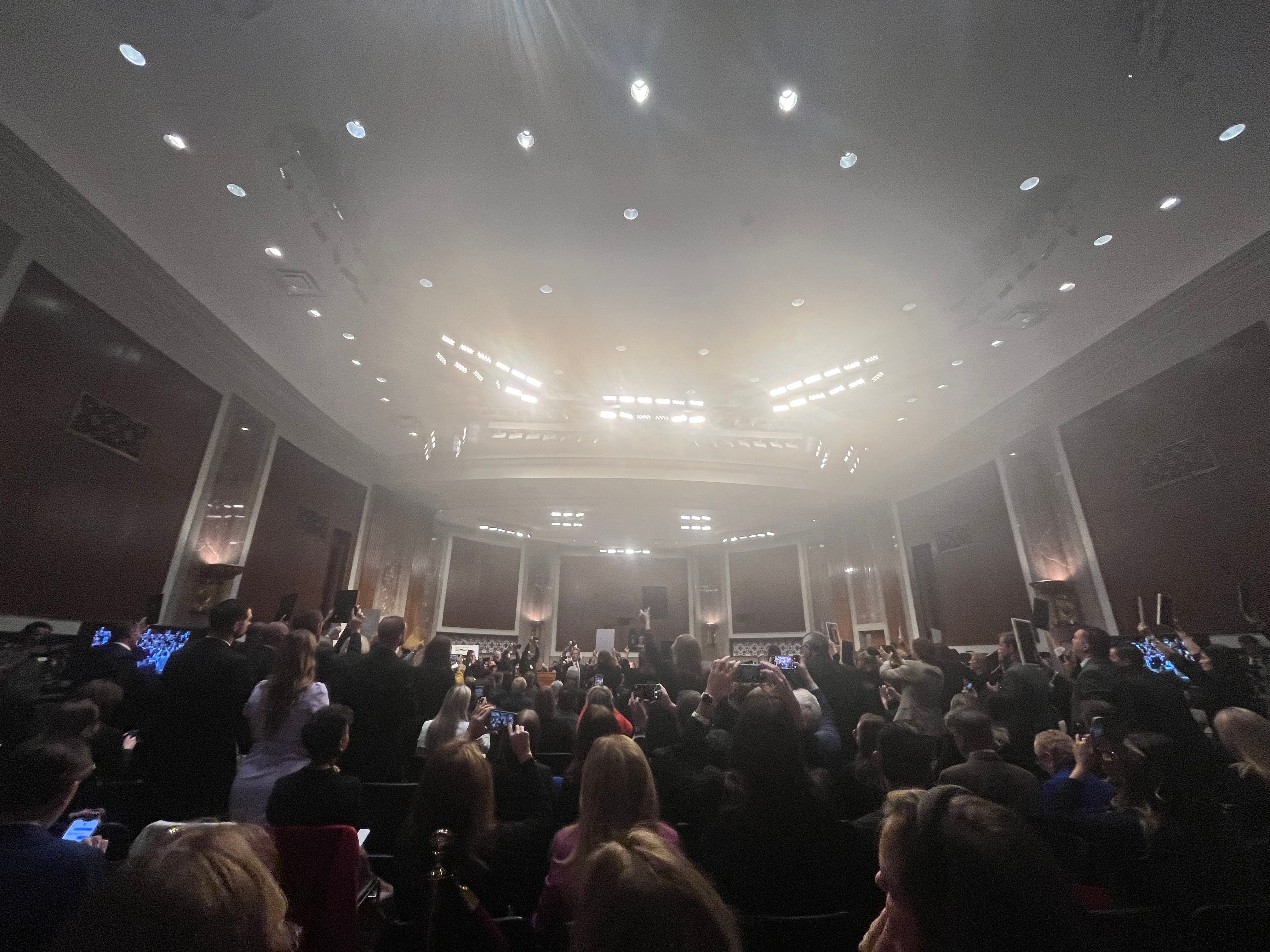
The big five tech CEOs faced-off with the bi-partisan Senate Judiciary Committee on Wednesday like a tired sequel. But something was newly charged about the room: the audience. Almost all were parents clutching photos of their loved ones, children and teens fallen victim to scams and exploits on social media platforms without recourse.
The mood was somber, even church-like as Chairman Durbin’s gavel broke up mutterings and the small cadre (of the hundreds who had lined the hallways since dawn) filled the remaining seats. Durbin led with a jarring disclaimer: only two of the CEOs had come voluntarily—Meta’s Zuckerberg and TikTok's Chew. The other three were subpoenaed, one was forced to his seat by court-martial—the CEO of Discord. He also added for the record, that many of the safeguards the tech leaders would soon boast to placate concerned committee meetings and parents, were implemented just a few days ago.
I had not heard of Discord before this hearing, a platform that connects users by interest or specialty, but the other players were household names—X, Snap, Meta and TikTok. I admit, streaming the court-martialing of a tech CEO would have been a more titillating jumpstart to the hearing but within the confines of the hearing room, Discord’s CEO, Jason Citron, was oafishly reverent.
The opening monologues by the CEOs were tidy but unconvincing. A forgettable swathe of self-congratulatory rhetoric on how social media is a wondrous, benevolent genius, making the world a better place by keeping a disconnected world connected. They are heroes not villains. Fellow parents not scammy predators. Any harm done to children or teens on their platforms is unfortunate, sad, tragic, unintentional, and not their fault, it’s yours. Well, the blaming came later.
Citron had the most to say when it came to newfangled safeguards at Discord. For example, digital buddies called “teen assist” described as a kind of in-app avatar-friend, follow and warn you of time lapses or potential stranger-danger. Evan Spiegel’s monotoned voice was eerily hypnotic when mentioning he's a concerned dad just like you…my notes say “he’s droning on…” with a laughy face next to the part where the original name of Snap was outed, Peekaboo, which smacked of accidental and off-putting innuendo, stirring the crowd. Although hide-and-seek wasn’t a bad description for the dynamics of the hearing early-on, senators took turns bloviating to ten while tech moguls hid in plain sight.
The main comittee beef with Snap was its encrypted, disappearing texts and photos allowing bad actors to more easily distribute CSAM (Child Sexual Abuse Materials) and evade tracking. This topic didn't get enough play in my opinion, and again, felt like a metaphor for how weightless the committee’s messages hit against the invincible deafness of the techies. Shielded as they are by Section 230’s (aka 26 words that created the internet*). The arcane legal immunity coupled with tricky intricacies of backend “safeguard” controls that change on a whim without warning— now you see the parental controls, now you don't—seemed to echo the vibe in the room—all indictments would soon vanish once the committee adjourned.
TikTok's Chew had the elegance and poise of a foreigner trying not to count the minutes until he was sky-high, reclining his lie-flat, off to that immaculate Singaporean utopia, his primary residence. Faraway from the controversial American Tiktok experience he helms, safe in a place where regulations are de rigueur and he admitted, there is no “under 13 Tiktok experience” to ensnare his young children.
Chew’s patient defensiveness brought calm and class, if not disclosure. He was pushed a few times to give account for the differences between the Chinese and US TikTok platforms, math and science feeds for Chinese children, pervasive distracting smut for the Americans, and questioned on the latest TikTok smear. A prominent Israeli TikTok lobbyist had abandoned post just the day before the hearing, alleging chitchat on Tiktok’s internal communication system was dominated by pervasive pro-Hamas rhetoric and anti-Jewish state sentiment. Could TikTok finish off Israel with its flashy propaganda and vile feedback loops? Chew didn’t think so. To him it’s all overblown. He came off as the wisest of the bunch, safeguarding his family on a ritzy sunshiny island far from accusations that TikTok is spyware for the Chinese Communist Party. Wheels up.
Zuckerberg with his telltale deflections and strikingly more voluminous hairstyle, was grilled the most while Twitter’s new CEO, Linda Yaccarino, was left to twirl her hair. After all, X is not much of a draw for the tweens and teen set. The only woman on the panel, she was the most agreeable to the various pieces of legislation, responding with wordy yeses when asked if X supported various proposed senate bills. Though her comments felt somewhat saccharine and canned, her presence exuded peppy compliance.
Midway, the vibe settled into a cordial ping-pong until Zuckerberg said flatly “there is no link” between social media and adverse mental health for teens, evoking ire and civil ruckus. A dumb move, one I hope even he immediately regretted. The brazen comment gave way to a slew of stats, rebuttals, and visual aides on social media’s detriments to teens and tweens, summarized best by Senator Blackburn. “When you are online—you are the product. [The platforms] thrive on your addiction ... [the algorithms] are meant to keep you there and not let you go ...the more time you spend, the more data you're producing, the richer and more valuable [you are] when they sell [your] data. Kids and teens are prime targets. Also peaking along this use trend, mental health disorders.” Coincidence? I think not. “Big Tech has turned a blind eye.”
When pushed on any extra responsibility Meta may have to protect its underage users, Zuckerberg suggested that regulation primarily falls on the parents. And as it’s likely not a stretch to say that even with two-income families, moms are the default parent, Zuck resorted to that ancient of scapegoats: Always blame mother. Insufficient and alienating.
The talk on parental responsibilities gave way to talk on parental controls which seemed simple enough until I listened, and it was anything but. Parental controls began to sound like a game of funhouse run by ever-changing rules hidden in near invisible revolving consents. Toggles coming un-toggled without notifications perpetuated by forced software updates and backend maneuvering. What is going on here? The only analogy I could think up was Vegas. The house always wins. Whatever is going on with the complex, multi-stepped evolving controls under the whimsy of updates, rest assured Meta, or the platform of choice, has the upper hand.
Next, Senators Cruz and Blumenthal brought out evidence that undermined Zuckerberg’s testimony that he was a good actor when it came to underage users of his platforms with the Nick Clegg email leaks. Clegg, a former Meta employee, expressed frustration over how Zuckerberg had not taken the “well being” project Clegg led, seriously. Stating it was obviously not a priority as none of the metrics had been met to help young users.
Then came the most palpable moment of all. The highlight of the entire day. Senator Josh Hawley took the mic and goaded Zuckerberg to turnaround and face the families whose teens had been unsuccessful in getting Meta to remove explicit images, those solicited by overage adults luring some of them into scams and all of them into danger, those who died senselessly of suicide through quagmires enabled in no small part by the stubborn do-nothing stance of Meta and its cohorts.
In response to Senator Hawley’s righteous outrage, Zuckerberg rose almost involuntarily, tongue-tied and obedient, and did something wondrously unthinkable. He apologized. “I'm sorry for everything you have all been through," Zuckerberg said. "No one should go through the things that your families have suffered.” Good for Zuckerberg, because finally there was reason to exhale, a modicum of decency; sincerity had broken through.
Then the most damning evidence for Meta came next, the “see results anyway” buttons highlighted by Senator Cruz. A pop-up users receive when intentionally or unintentionally accessing CSAM through their platforms. In other words, instead of identifying and expunging such materials, users were/are given a warning and workaround to access the material anyway.
Finally, the heart-wrenching and infuriating testimonies of victims in the room, using senators as their voice pieces, touting the many times parents and victims tried in vain to connect with the gods of connectivity. Reporting, flagging, following endless and impersonal prompts that sent their laments and requests into the nebulous ether. They asked, begged, demanded in vain that explicit materials be blocked or removed, that harassment be stopped at the algorithmic level. A level these parents could not access or alter themselves.
Their efforts were futile.
Of those who received replies to their urgent asks, most were sent formnote blurbs stating their flagged material “didn’t violate company policies.” Nothing would be done. One mom received a response notice two years after reporting the material, her son now dead by suicide.
All the evidence highlighted a dangerous hypocrisy.
Big tech says it provides a space for warm buzzes of world-class connectivity that make our lives better. If that’s true, why does Meta ghost their most vulnerable users in time of need? Teens.
But tech isn’t solely to blame. When dogged hypocrisy meets government impotency, nothing moves forward.
What is wrong with a senate body that can’t get simple bills protecting children to the floor for a vote? Have they been worn down by a learned helplessness from all the years of naive hoping against hope that big tech, the most lucrative business in capitalism’s history, will self-police?
This impasse can only be overcome when the senate body musters the authority they’ve been given by their voting populous, and decide to stop debating and do something. Take the bills to the floor, expose those who oppose the basic decency of what they espouse, move passed obstacles, and implement legislation that protect our most fledgling citizens—children and teens. As Senator Klobuchar remarked with the fatigue of a parent worn down by the lies and shenanigans of teenage kids, “we’ve had too much talk.”
Agreed—time’s up.
It’s time to kick big tech where it hurts—their bank accounts. Senators should stop begging for big tech’s endorsement and buy-in and accept reality.
Self-policing is a fantasy.
Challenge the money-drenched behemoths, as Senator Lindsay Graham said, to “stand by [their] product.” Rework 230. Remove immunity and let the court doors swing open.
The only way to reorder tech’s financially driven priorities to start innovating effective, user-friendly safeguards that actually protect American’s children from loss of innocence and senseless, early gravestones is by exposing them to the financial consequences of their relentless apathy.
_____________________________________
*Section 230 in a nutshell: "No provider or user of an interactive computer service shall be treated as the publisher or speaker of any information provided by another information content provider."