
Of Things Eviscerated & Still Standing
Palisades Inferno Part I

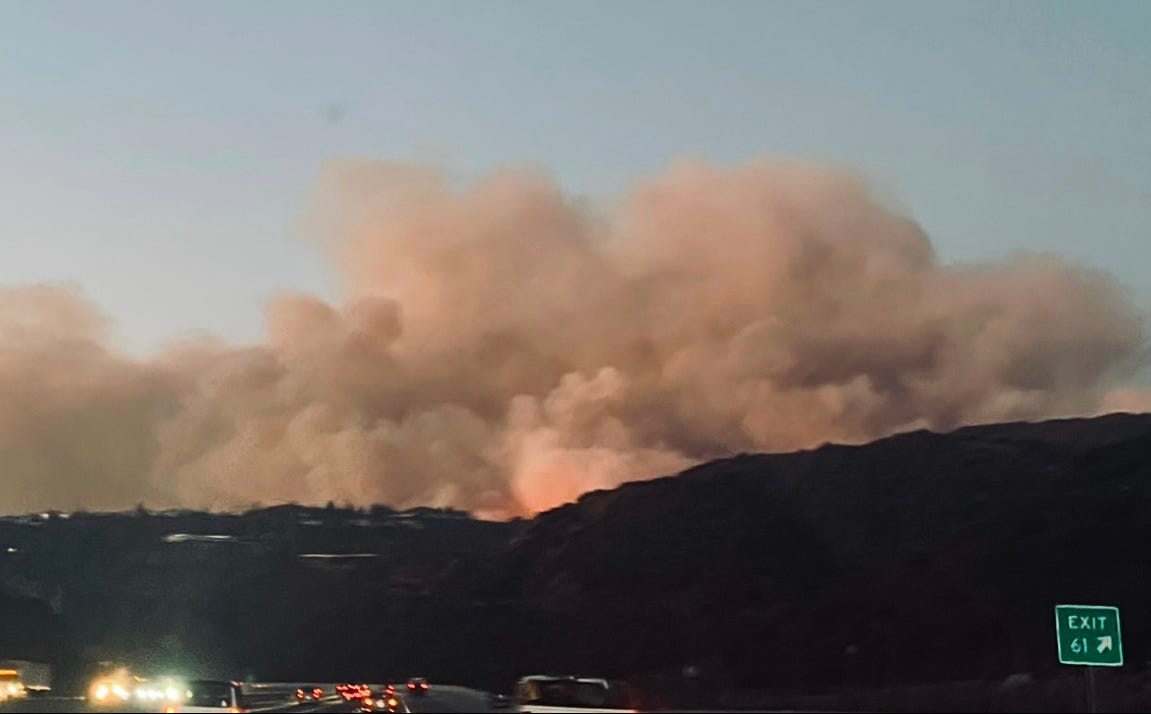
When the embers were still smoldering and pockets of fire still breaking out, one of the young, rugged independent journalists had mercy on some residents hiking up—against ordinance—to confirm the worst: their homes were rubble. Using his press badge, not as a disaster tourist like so many attention-getting celebs, interlopers, and firefighter funders hitching rides from the Orange County outskirts for photo-ops, but to help real victims. The journalist described the view from one section of Sunset Blvd something like this. Everything is gone; everyone has an ocean view. The distance between Sunset and what was called the bluffs is a three-minute slow drive through stop-signs and over bumps cluttered with cottages all once bandying for and advertising full, partial, or peekaboo views. Now there was nothing. The new abnormal: everything level.
The first afternoon, evacuees shuffled through hotels on and off the phone, glued to local news hoping the winds would stave and their homes would make it through the night. As dark set in, realizing there was no going back and scrambling to house us, I called a friend in Beverly Hills asking if part of our family could bunk up—five humans and two dogs is a lot for hotels. He said, no need. If your house burns, all of Palisades will burn. Impossible odds.
So I sat there on a blue-green velvet bench in the Fairmont restaurant holding our squirmy dogs watching the displaced pour in, the winds so high the vault-heavy doors whacked erratically about them. Ordered a glass of champagne to keep my seat and because my foot was either broken or a muscle had snapped—an indulgence doubling as a pain med—and soon, was wistfully caught up with a woman’s story next to me. A quick escape with her elderly mother, and then like most conversations in Los Angeles even in heightened stress, I learned she was a creative, a bag designer—beauty took the fore. I spent a wonderful half-hour oggling her bags online, brainstorming off-shoot marketing ideas, forgetting the mayhem, effortlessly making a new friend.
By the time I finished my drink, the hotel was booked. My kids were happy bounding around with schoolmates so I texted an SOS to family friends in Venice and by bedtime, we ubered their way.
The TV images were all fire. So much fire you could hardly make out the structures. Before we fell asleep, our kids got word that flames were at their best friends’ doorstep—a second home to them for a decade, and a few blocks from our own. They sobbed into the wee hours asking—where are we going to go? What are we going to do? We held them tight. It wasn’t so much the home itself. Though we had lived in Pacific Palisades over a decade, we had just returned after a few year COVID hiatus that summer. It was more the life they knew, the people they loved and worried for—their childhood, and okay sure, a predictable roof, their favorite jellycat and hairbrush. The “thief in the night” had come for us, snatching our tender (and still re-grafting) olive shoot from a now choking tree.
Huddling there in our friend's studio guesthouse in Venice, piled up together, my husband and I had no certainty to offer our kids as our phones alarmed with evacuation warnings and the weather app registered 65mph winds. But somehow in the silence, I thought of a song from Sunday school and started singing, He’s got the whole world in His hands…naming our kids and friends our neighbors and schools. We slept a rocky few hours; by daybreak, our house was standing, so too, our friend’s.
But the impossible had happened and would continue to happen. Our schools and churches incinerated, caught on live TV or ring cameras. Not even the inventor of the ring camera himself went unscathed. Rumors soon circulated that the entire Alphabet neighborhood was gone. The oldest neighborhood in the Palisades built by Methodist missionaries envisioning a religious-intellectual community that would eventually harbor Jewish intellectuals and artists fleeing persecution—was also the first neighborhood we lived in Palisades. The one flanking the glitzy center Rick Caruso built known now as Palisades Village. The Alphabets, gone? The whole neighborhood, nothing?! It was incomprehensible. But the grim tally grew from one neighborhood to nearly all in detailed confirmations through moms' threads—we lost ours last night. Ours was gone an hour ago. Does anyone know if Toyopa is burning? Another one just broke out on Chatauqua. Upper or lower?
Two nights in a row, three fires surrounded our house—one atop, one below, one beside. And though firefighters were defending it—a real crapshoot with so many fires everywhere—it didn’t look good. The second night, we were evacuated again, this time from the Santa Monica hotel we had just cozied up in. My foot was still lame so I was tottering on crutches borrowed from a mom with teenage boys. The only place we could find a bed for the night: invulnerable, price-gouged Beverly Hills Waldorf Astoria. Our abandoned car was likely charring near the girls’ school, along with my purse and identification, and my husband had just left town for two days so a friend swooped in to be our driver. With no ID, I wasn’t allowed by California law to rent a car. A photo didn’t suffice; I was told to go to the DMV for a temporary license—unthinkable on a regular day much less this one.
The ride down Wilshire was unusually fast and unsettling. With everyone gone or sheltering in place, there was no traffic. The memories of the day skittered—disparate, ethereal things floating like ash, hard to gather. Through a glass darkly, shards flashing sharply. Black smoke enveloping, ridges flaming over the heads of children unsteadily emerging.
By contrast, the morning of the fire was one of the most peaceful in a long time—the first school-day back from Christmas break. As were the days leading up to it. I kept saying: I feel such a palpable peace. We had driven back from Utah listening to Dante, not getting past Inferno. Returned to piles of laundry and a family outing to the co-op for groceries. A wonderful, and all too rare, unity permeated our family as though we were actively becoming one thing. As though something invincible but invisible hovered with us, tethering us closer together, holding us there.
The night before, my husband played piano, my daughter joined in with her violin, an impromptu living room concert fireside while my youngers played a board game. I slouched to read, waiting for pasta to boil, the dogs snuggled up next to me. It was the kind of magical togetherness that was hardwon after all the upheaval moving from the east coast back to our beloved Palisades that summer. It had not been the easiest of moves. Old friends and zipcode but all new schools. All the adjustments and heavy lifting, the organizing of downsizing and streamlining. Listening to their music, I thought of what my husband said as we re-entered Los Angeles from the desert on our ski trip. I feel so much hope. I love Los Angeles. I am so happy we came back. I exhaled. It was a beautiful decision.
Many back east questioned our move. Most people thought of Palisades as an opulent enclave out of touch with the real world, but what we found in Palisades was a multi-generational community that never let go doing life together. (I am able to write this days after the fire, because my kids are being entertained by our closest friends far from the smoke and ash). The kind of community people talk about wanting but rarely experience. It wasn’t really the sunshine or proximity to the goods that surround the moneyed class; it was a sacrifice for us to live there. It was the people that drew us back—the creativity, dynamism, the unspoken agreement that life was worth living hard now while our kids were still at home with us. I had missed moms who used their resources to create but still cared deeply about family. I once said that Palisades was for better or worse, the most traditional place I had ever lived. The women were free to be moms. The men were free to hunt and gather, the children were safe. As kids grew into elementary school moms got antsy so many of them started brands that you use everyday, things that you love like Summer Fridays and Mother jeans, some of them managed talent you admire, some of them are the talent, some ran shops that brought Paris to your backyard. None of them probably had to work, but all of them had the verve to create something for the world. I missed this energy most living on the east coast. Work within limits, family, balance, and al fresco dining. What burned in the fire were homes and heirlooms and kids' art but what also burned was a dynamic hub of ingenuity and togetherness held intact by unspoken agreement—stay aflame, burn strong, burn hard. Not because we die, but because life is beautiful.
At 8:20am I drove my kids the long way up to the top of the mountain where the classrooms nestled because my youngest was angsty and I thought breaking this small rule by going through the preschool carpool line was worth it. I saw the bright and beautiful head of school and waved, a little apologetic for my misbehavior. She laughed me on—it was gonna be a good day.
I was still in awe of this camp-like campus, how sprawling it was how ensconced in the mountain like a storybook. My youngest had just written a paper on its history and magical views, the mountain lions that roamed and the cemetery holding its originators. What a hub for the community it was able to be by sheer surface area—a swimming pool, and out cabins, amenities for camps and scouts etc. Today it sparkled, chest out.
As the kids exited, I would usually say a rote prayer that made me feel good and irritated them. But that morning, I had more of a burden for the school and my youngest daughter struggling to find her place. I began to pray for angelic protection around her, and then for my elder gal too, as they climbed the stairs up, up, up, to classes. Driving back down the hill through the campus murmuring my imperfect mom prayers, I saw something in my minds-eye, a host, a gorge of angels really, and said to myself—why would they need all those angels?
Turning right on the one-way canyon, I remembered something my husband was telling a six-year-old boy over Christmas break, struggling at school with his peers—did you know your angel always sees the face of God?—quoting the book of Matthew. I turned left on Sunset heading to Erewhon for provisions, satisfied by those words: where there are many children, there are many angels. Where there is smoke, there is fire. As logical as logic can be.
In the meat section, I tried to figure out if tri-tip or tenderloin was better for slow-roasting roasting, another one of my New Year’s resolutions put to task that morning. Pray for my kids, check. Cook at home, check. Neither was exactly right so tri-tip would have to do. I was not going anywhere else due to by third New Year’s resolution—reading and writing by the fire for ninety minutes. I bought a few veggies and a chai, lingered in the sun looking at the village thinking what a beautiful year 2025 was apt to be. I texted with a dear friend in England: all is right with the world.
At home, I chopped carrots and braised the meat. I think I was singing when four metal heaters crashed and busted outside our kitchen window. The winds are high! I called out to my husband but he didn’t seem concerned. I poured some beer over the fixings and noticed it was close to 10am so I started a fire and pulled up my grandmother’s burnt orange chair, Dante, and the bible. I had been researching ideas of hell for a writing project I tentatively called—Portrait of a Woman Buried Alive—and was curious to see how Dante’s account of hell corroborated with what the bible described. I texted my husband working in the other room some of my findings—whoa, this is wild. Everyone will be salted with fire. The commonly known verses appeared—the worm doesn’t die, the fire is unquenched. I was stuck on one thing: What in the world is brimstone? I was writing that question in my text notes when the first school text pinged at 10:27am.
Parents, we are aware of a nearby brushfire. Do not come to school.
I was not one iota alarmed by this alert. We had just had a near-miss evacuation from the Malibu fires before Christmas so the ping was unsurprising with winds in dry season. I kept reading, cross-referencing fire and hell, zeroing in on this… If anyone's work is burned up, he will suffer loss, though he himself will be saved, but only as through fire.
The wind whirred through the fireplace; I cozied up all the more. Eight minutes pass when a series of dings and autocalls resounded—the school is being evacuated now. I casually asked my husband if he would like to come with me on the drive to get the kids adding something like, it will be nice to have them around; we have roast cooking. I glanced at my tennis shoes but decided on wearing the furry flip-flops already on my feet. I wouldn’t be getting out of the car anyway. Husband asked if we should turn off the fireplace. I shrugged, if you want. He turned off the gas and we got in the car.
With him driving, I decided to look at the traffic in case of snares. Sunset was jammed red, so we drove down to PCH. Over the highway and the ocean, a heavy white plume wafted. I took a picture without a hint of foreboding. We had seen many smokeclouds in our Los Angeles years. I had once sat on PCH during college watching embers jump from one side to the next without flinching—enjoying nature’s spectacle. I simply thought the contrast in color and texture was beautiful— sharp cornflower blue sky, pillowy milky white smoke. We turned right up the street that goes past Pali Highschool and before we are halfway up, it was obvious, the source of the fire—grey with a jet-black center—was coming from, if not right on, way too close to our kids' school. I panicked. Husband ran the only red light on the road between us and Sunset—honks, pivots, and jerks.
At the intersection, traffic was clogged. My husband bolted out of the car and started sprinting. For a doctor black smoke wasn’t fires, it was lungs. The idea of small bodies passed out all needing to be hauled with only one-way out. I drove in awkward weaves making my slow jagged way as the smoke poured continuously, a waterplane dove overhead maneuvering its way through the canyon, and called my mom, blubbering and unintelligible except maybe the word—pray! On the sidewalk, other moms were running from what looked as far as the village. Seemingly having abandoned their cars in hopes their legs would carry them faster. I tried in vain to get one mom into my car, but couldn’t tell if she would make it before me or if I would. Her face was shock-white, a look of imagined grief and exhaustion registering doubts that her lithe body would make it to her kids in time, huffing words, barely getting them out. I need to get to my kids—that’s my kids’ school.
Suddenly, I was able to lurch ahead and make the turn onto the canyon road of the school finding more gridlock and more black smoke. I skidded to the side, jumped out, threw off my furry flip-flops, and darted off in socks. I am three quarters to the school when my left foot goes lame. I keep running on it until I collapse: it hangs oddly. I yelp to another mom asking her to grab my kids. Just then, my husband laps me.
A few minutes later my girls emerged frayed but unharmed. My husband carried me to a strangers car heading out of the canyon—it hadn’t moved from that spot since I started running. Noticing this too, he took our girls to the intersection where they direct traffic out with another dad. Eventually, they walked towards the village and hopped into a random car that turned out to be a friend. The car I was in, picked up a stranded dad and girl and the driver’s elderly mother, and we headed down away from the smoke towards the ocean. My husband would get passports and my wedding rings and hand our kids off to one of our best friends along with our dogs, hours later we reunited in Santa Monica. Two days later I would learn I had snapped my Achilles tendon entirely.
By daybreak, most of those I saw that morning, the moms and dads heading out of the canyon with their children, would lose their homes, some only hours later. One was watching hers burn as we drove to the ocean. The overwhelming majority of families we know will have lost their worldy possessions without a chance to grab a thing. The very few with homes standing will be outside the palisades, the few or lone sound structures surrounded by ashen slabs, or those closer to the ocean and farther from the fires source, mostly the super rich with access to private firefighters and reinforcements, or those few brave homeowners and hired hands using pool pumps at their own peril.
The Sunday after the burning devoured Palisades, I hobbled on crutches into what felt like a funeral mass for our girls’ former elementary school and the church they took first communion. My husband lugged me up the spiral staircase to the balcony. High up, I could see familiar friends and parishioners, and would hear the most comforting voice I had heard since everything broke, the priest. His telltale mix of gravitas and unencumbered hope, sobs broke out watering scorched ground. I clutched a stranger's hand behind me and didn’t let go as Father Kidney spoke.
I don’t know about you—he said—but I’ve been in an out of body experience for a few days. Hovering over the wreckage wondering, what is going on, continually asking—what is going on, what is going on?! Then, with a voice able to raise the dead, he boomed. I am what’s going on! You are what’s going on! We are what’s going on!
For a moment at least, we came down from the hovering. From the dissociation of a near-death experience back to the cold hard marble sanctuary surrounded by people, the church, and the Eucharist.
My mind seated itself back in the comfort of my grandmother’s orange chair—and the verses I was pondering the morning of the fire. Anyone who builds on that foundation may use a variety of materials—gold, silver, jewels, wood, hay, or straw…
Jarred awake by the exhortation, the priest offered an invitation. Would we stay floating and disassociated above the rubble like smoke and ash? Or would we re-inhabit our lives, our own bodily temples, even though most all our brick and mortar temples were now rubbish.
I had heard near-death experiences where people see impossible things like the price tag on top of the fan overhead them while doctors resuscitate. And that people sometimes report they get to make a choice: go back to the ravages and fragility of the human experience and the human body, or leave for good. Along with the physical miracle—the tabernacle box holding the Eucharist inside had been the only thing to survive intact and unscathed by the fire—Father Kidney performed another one: a call to reintegration, the dignity of choosing. The fire may have left us no choice, but we get to choose what we do next.
In subsequent days, the logistical overload and the mounting paperwork became the new rubble. The suspense alone of when will our girls be back in school? Is the air safe? Will we ever be able to access our house? What is the victory in a house standing when a community is eviscerated?
All the unanswered questions and sharp turns kept me going backwards to pick up the shards, piecing them together to see what picture they may form. Back to the billowing jet-black smoke and to the meaning of words spinning around like the winds that day. That particular black reminded me of being an intern in DC, the Pentagon burning. I wondered if “jet” was something to do with jets and jet fuel. I looked it up and found it was something else altogether, something more meaningful, maybe holding a message I am still working through. Jet is a kind of coveted material used in jewelry-making since the Neolithic period—wood that changes and fortifies under extreme pressure and heat turning it dark black and making it onyx smooth, giving it weight and value.
A new fire broke out in Brentwood while we were sitting in an eight-hour line to nowhere trying to get to the checkpoint to see our house. It felt like tenth Saturday, we said, a blur of nondescript days and misinformation. We had received emails about FEMA’s presence but had never seen them on the ground, spotty instagram tips about curfews and how to access Palisades, National Guard everywhere but only to bark about where people are parking instead of helping the LAPD expedite and transport residences through checkpoints to their homes. They were taking cars up in threes regardless of neighborhood with hundreds of cars in line. Only the ones arriving between four and six am had any luck that day.
My cousin, a studio exec, and I marveled at the ironies. This complete inefficiency in the state that invented digital cues and fast passes, in a country with Chick-fil-A lines. We moved a total of three feet in seven hours and wouldn’t make curfew at this rate to get into our home to grab my daughter’s specialized back brace for scoliosis and my contacts so I could see. Provisions from local shops kept us fed and offered restrooms, towing me to and fro the farmshop due to my crutches. I clomped passed a familiar couple—filmmaker David Mamet and his wife, Rebecca Pigeon—at the same watering hole, one of the only places open. And committed to a new resolution within reach—speak up. Today this meant telling Rebecca Pigeon (the lesser known of the two) how much her hauntingly beautiful music helped me through coldest darkest winter in Poland, early years with kids, and now perhaps these fires.
At seven and a half hours in line, my mom and girls found another route to the house. They walk-jogged a mile on PCH trying to beat curfew and found favor of an officer who remarked he had not escorted anyone to a house that was still standing that day; he jumped at the chance to help them up to the house then drove them back to me, back-brace and contacts in tow.
When our children were younger and we lived in the heart of the village, we scootered to school attached to the church. One or two priests would greet us, cheering us on for our valiant effort—kids clothed and mostly to school on time. Father reminded us in his post-fire homily how he would often ask the kids—where is the church?! The child would almost always say—there is the church!—pointing to the nearly 75 year old building. Then the priest would retort—No! YOU are the church!
One thing is for sure—the churches, temples, the schools, the theaters, and all the many beautiful people of this town have been salted with fire. We have all been forever changed under high heat and intense pressure. We may always smell the smoke, maybe even smell of smoke. Not as the scourged but as forerunners and harbingers. Reminding us all, onlookers great and small, pure or ill-motived—to build well. If they haven’t stoked already, your fires will come too.